Web3 was supposed to decentralize everything. Then AI walked in.
AI can make decentralized systems easier to use, but who governs when proposals, summaries, and decisions depend on a centralized model?
By Emmanuel Itighise
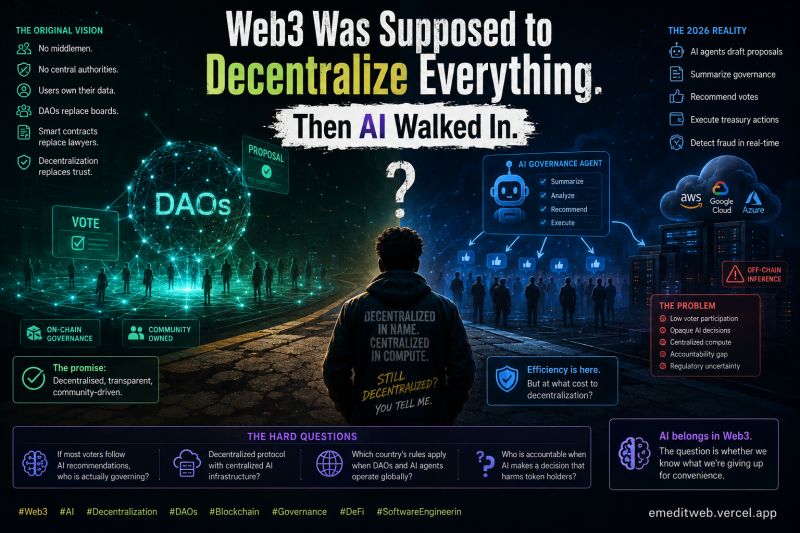
The original pitch for Web3 was simple. No middlemen. No central authorities. Users own their data, govern their protocols, and transact without permission from anyone. DAOs replace boards of directors. Smart contracts replace lawyers. Decentralization replaces trust.
That was the vision. But I've been watching what's actually happening in 2026 and the picture is more complicated than the pitch. AI is now deeply embedded in Web3 infrastructure. AI agents are drafting DAO governance proposals, summarising 40-page discussion threads so token holders can vote without reading everything, rebalancing DeFi portfolios across chains, detecting fraud in real-time, and even executing treasury actions autonomously when predefined conditions are met. On the surface this sounds like efficiency. And it is. But here's the question nobody is asking loudly enough: if an AI agent is drafting the proposals, summarising the context, and most voters are following the AI's recommendation, who is actually governing?
Who is actually governing?
The decentralization thesis assumed that humans would participate actively in governance. The reality is that DAO voter participation has always been low. Most token holders don't read proposals, don't attend governance calls, and vote based on whatever summary lands in front of them. AI didn't create that problem but it is accelerating it because now the summary itself is generated by a system that the average voter can't audit, can't explain, and didn't choose. You went from "don't trust a central authority" to "trust this AI agent that a core team deployed."
The infrastructure question
Then there's the infrastructure layer. Web3 was supposed to remove dependency on centralised platforms. But most serious AI inference still happens off-chain on centralised cloud providers like AWS, Google Cloud, and Azure because blockchains are terrible at high-speed computation. So you have a "decentralised" protocol whose critical AI component runs on a server owned by one of three companies. The governance is on-chain but the intelligence driving governance decisions are off-chain and centralised. That's not decentralisation. That's decentralisation with a centralised brain.
Convenience has a trade-off
As someone building on Stellar/Soroban I think about this constantly. The promise of Web3 is still worth pursuing but we need to be honest about where AI is centralising what was supposed to be decentralised. Using AI to make decentralised systems more usable is genuinely valuable. Using AI to replace the human participation that decentralisation was built on defeats the purpose.
The question is whether the communities using it are paying attention to what they are giving up in exchange for convenience.
Decentralised in name. Centralised in compute. Governed by algorithms most participants can't read. Still decentralised? You tell me.
About the author

Emmanuel Itighise
Founder of Stepfi-App, @Pulsar-Stellar/sdk, and Trybe.
Emmanuel Itighise, known online as Emeditweb, is a full-stack and AI-native developer based in Lagos, Nigeria. He builds practical products and developer tools, with a focus on web applications, AI, and the Stellar ecosystem. He shares lessons from building in public, contributing to open source, and turning ideas into working software.