The Cloud Is Not Magic: Chips, Hypervisors and Who Really Owns the Machine
The cloud has a physical body: chips, power, cables, hypervisors and laws. A look at the technology that makes cloud computing possible—and who really controls the machine.
By Emmanuel Itighise
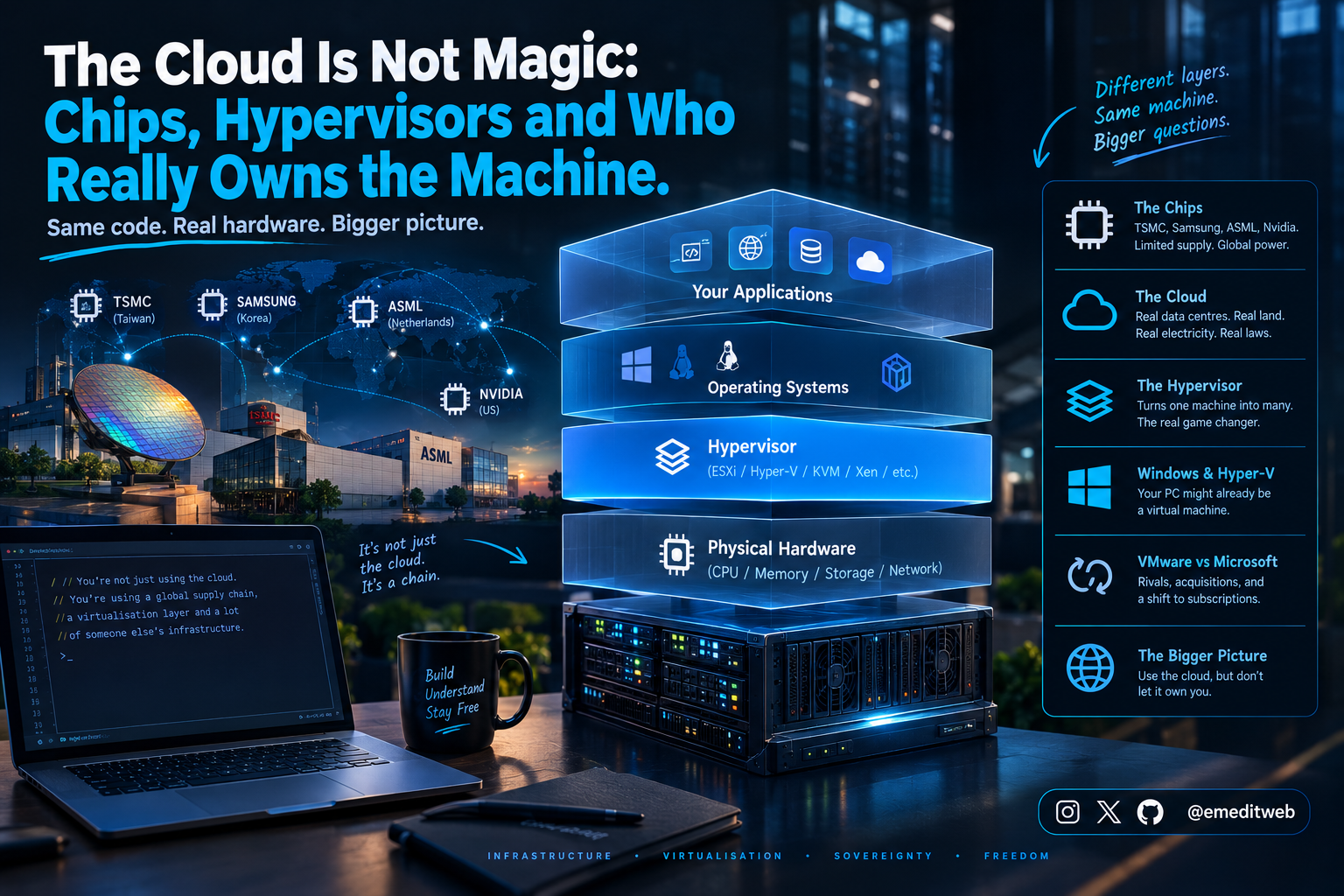
I had a thought recently that I couldn’t shake. When we say “the cloud”, we make it sound like the thing has no body. It does. Once I started pulling on that thread, I ended up in the history of the hypervisor, which turned out to be the most important trick in the whole story.
Cloud is physical
We write s3.putObject() and the file is “somewhere”. That somewhere is a building full of servers, which needs land, electricity and cooling. Those servers run on chips that only a handful of companies in a handful of countries can make: TSMC in Taiwan, Samsung in Korea, ASML’s lithography machines from the Netherlands, Nvidia’s GPUs designed in the US. If you can’t build the chip, you can only rent it.
That is the part I find fascinating and uncomfortable at the same time. For a startup in Abuja or Nairobi, renting from AWS, Azure or Google means access to infrastructure we could never build ourselves. But we also never own the factory. The more we build on it, the harder it gets to leave. I’d call that lock-in, and it is built into the product.
Sovereignty comes into it too. The US CLOUD Act lets American authorities demand data from US providers even when it is stored abroad, and how far that reaches is still debated by lawyers. That is why China built Alibaba Cloud and Russia built Yandex Cloud. Your data doesn’t float. It lives under somebody’s laws.
The trick that made cloud possible: the hypervisor
Here is what changed my thinking. Without virtualisation, cloud is just expensive dedicated servers.
In the old model, one machine ran one operating system for one owner. If a big server ran a small accounting app at 5% CPU, the other 95% was wasted, and you could not share it. A hypervisor changes that by sitting between the hardware and the operating systems. Each virtual machine believes it has its own CPU, memory, disk and network, and the hypervisor is the one making that belief possible. One physical machine becomes many rentable ones.
That is where the economics flipped. Providers stopped selling servers and started selling slices of servers. Intel and AMD even built virtualisation support into their chips (VT-x and AMD-V) to make it fast.
There are two kinds. Type 1 hypervisors run directly on the hardware (ESXi, Hyper-V, Xen, KVM), and that is what the big clouds run. Type 2 runs as an app inside an operating system, like VirtualBox or VMware Workstation, and is mostly for testing. AWS’s own system, Nitro, pushes much of the work onto dedicated hardware cards with a very thin hypervisor on top.
Where Windows comes in
This was my own observation that started the conversation: Windows has a hypervisor of its own. Microsoft shipped Hyper-V with Windows Server 2008. When it is switched on, Windows itself becomes the first and most privileged virtual machine, called the root partition, and the hypervisor sits underneath it.
That matters more than it sounds. On a modern Windows machine with Hyper-V, WSL2 or virtualisation-based security turned on, your desktop is no longer running directly on the hardware. It is running on top of Microsoft’s hypervisor, and you probably never noticed. The security benefit is real: the hypervisor can protect things like credentials from the operating system above it. But it also means that whoever controls the hypervisor controls everything above it.
Microsoft was late, then it got serious
VMware had been virtualising x86 servers since the early 2000s, and it owned the market. Microsoft’s first attempt, Virtual Server 2005, was a Type 2 product that nobody trusted in production. Microsoft came to the game years late.
Its answer was not to build something much better, but to build it into Windows. Hyper-V arrived with Windows Server, so companies that already paid for Windows had virtualisation without a separate product. Then it came to Windows 8 Pro for developers, and Azure runs on a customised version of Hyper-V. For a while VMware Workstation struggled to run next to it on the same laptop. Microsoft turned a hypervisor from a product into a feature, which is a pattern it has used before.
So did Microsoft kill VMware?
No. VMware kept the high end, where features like live migration were hard to match. Then Broadcom bought VMware in 2023 for about $69 billion, ended perpetual licences, pushed customers onto subscriptions and focused on its largest customers. Many customers reported sharp price rises, and plenty went looking for alternatives such as Hyper-V, Nutanix and Proxmox, the open source option built on KVM.
What I take from this
The code we write is the thin top layer of a very physical stack: chips, power, cables, hypervisors and laws. Learn the abstraction, but understand what sits underneath it. Use the cloud, but don’t build so tightly on one provider that you can’t leave.
References
About the author

Emmanuel Itighise
Founder of Stepfi-App, @Pulsar-Stellar/sdk, and Trybe.
Emmanuel Itighise, known online as Emeditweb, is a full-stack and AI-native developer based in Lagos, Nigeria. He builds practical products and developer tools, with a focus on web applications, AI, and the Stellar ecosystem. He shares lessons from building in public, contributing to open source, and turning ideas into working software.