6 Security Events This Week: Is Farming the Way Out for SWEs?
Six security stories across PHP, Node.js, GitLab, LiteLLM, OpenCode and eMudhra—and what they reveal about patching, dependencies, and protecting secrets.
By Emmanuel Itighise
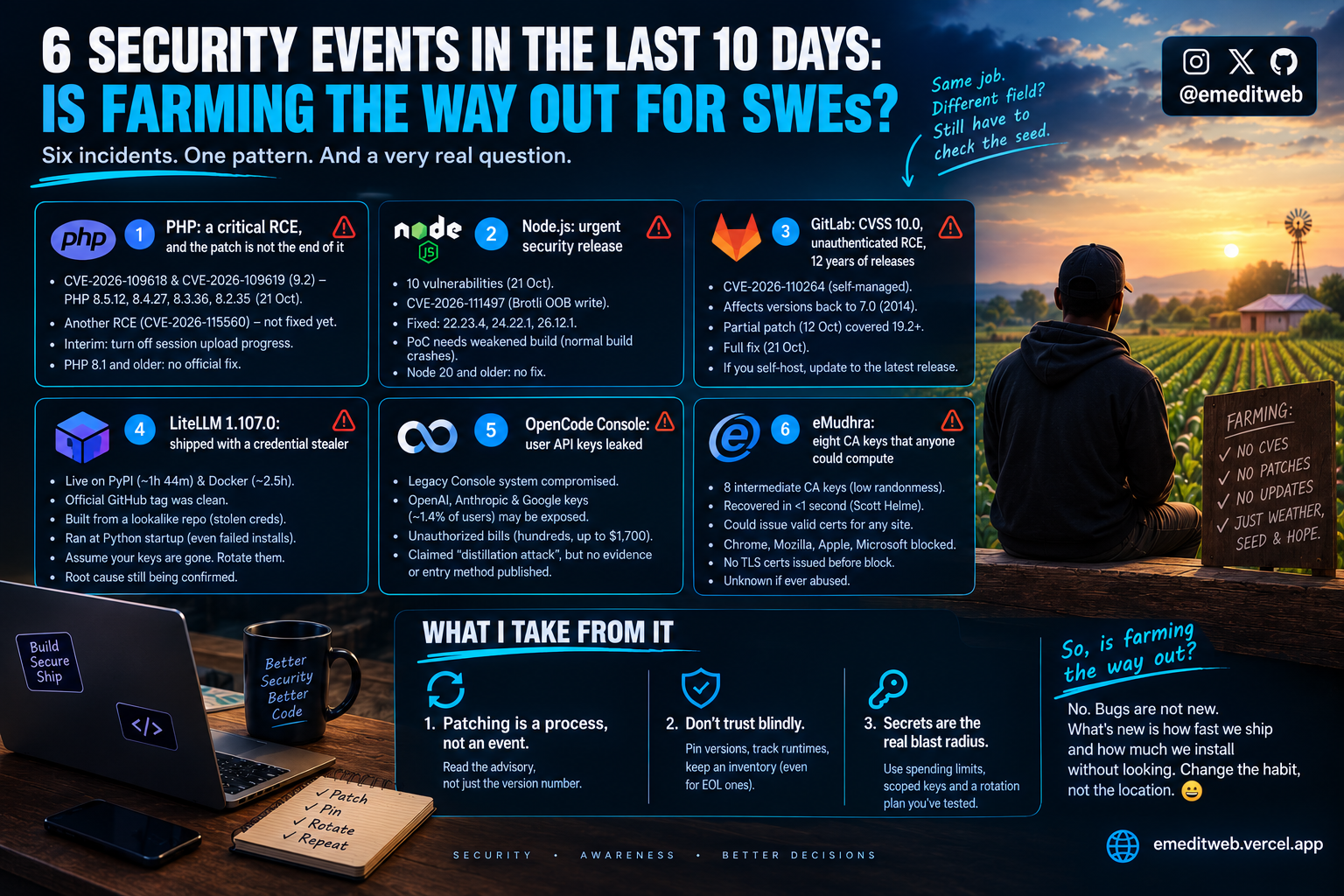
I’ll be honest. I opened my feed this week, saw six separate security incidents in a row, and seriously thought about buying land. Here is what happened, in plain terms, and what I think it says about our job.
Checked on 27 October 2026. These are the stories that filled my feed this week; some were first disclosed on 17 October. The cover infographic reflects earlier reporting. The text below includes newer findings on Node.js and LiteLLM.
1. PHP: a critical RCE, and the patch is not the end of it
Two critical remote code execution bugs (CVE-2026-109618 and CVE-2026-109619, both rated 9.2 under CVSS 4.0) got an emergency release on 21 October: PHP 8.5.12, 8.4.27, 8.3.36 and 8.2.35. Two days later PHP confirmed another RCE vector, CVE-2026-115560, that those versions do not close. It needs an unusual combination of session configuration and application code, and PHP calls the real-world risk unlikely. As of this post, the fix is planned for the next regular release. The interim step is setting session.upload_progress.enabled=0. PHP 8.1 and older get no official upstream fix; check your distribution or extended-support vendor separately. See PHP’s release and session advisories.
There is another wrinkle for Windows users: on 26 October, PHP published rebuilt packages, 8.5.12-1, 8.4.27-1, 8.3.36-1 and 8.2.35-1, to fix the bundled Brotli dependency. The PHP runtime version itself stays the same. See PHP’s Windows build announcement.
2. Node.js: urgent security release
Node shipped fixes for 10 vulnerabilities on 21 October. The headline one, CVE-2026-111497, is an out-of-bounds write in the bundled Brotli decoder. You are exposed if your app decompresses Brotli data an attacker controls, through node:zlib or automatically through fetch(). Fixed versions are 22.23.4, 24.22.1 and 26.12.1. Node 20 and older, as well as other end-of-life lines, receive no upstream patch. See Node.js’s security release.
The exploit evidence matters too. Imperva’s researchers report code execution on the official Node.js 24.22.0 Linux arm64 image, without a debugger or instrumented binary, and rejection of the same input on 24.22.1. Their setup required multiple attempts. That replaces the earlier claim that code execution required a deliberately weakened build; it does not establish reliable exploitation on every deployment. See Imperva’s research.
3. GitLab: CVSS 10.0, unauthenticated RCE, 12 years of releases
CVE-2026-110264 lets an unauthenticated attacker run code on self-managed GitLab under certain conditions, and the affected range reaches back to 7.0 (2014). The October 12 security release addressed an earlier related regular-expression vulnerability on the then-supported branches; installing it does not cover this October 21 issue.
The October 21 fixes are 19.5.1, 19.4.3, 19.3.6, 19.2.9, 19.1.9, 19.0.10 and 18.11.13. If you run GitLab yourself, check against the full affected-version list and follow GitLab’s required upgrade path. GitLab.com was already patched. Read GitLab’s critical patch advisory.
4. LiteLLM 1.107.0: shipped with a credential stealer
On 21 October a malicious litellm==1.107.0 went live on PyPI for about 1 hour 44 minutes, and on Docker Hub for about 2.5 hours. The official source tag on GitHub was clean. The delivered artifacts came from a lookalike repository through a compromised release pipeline. The malware ran at Python startup without needing an application to import LiteLLM, so even an installation attempt that later failed could leave an environment exposed if the startup files had already landed.
If you installed or ran an affected artifact, treat the environment and reachable secrets as compromised. Rebuild from a verified clean release and revoke and rotate the credentials the environment could access. Do not assume that deleting the package invalidates stolen keys. Follow LiteLLM’s incident and recovery guidance.
LiteLLM’s October 23 follow-up supersedes its early analysis. The maintainers say an exposed Agent Platform master key was never revoked, allowing the attacker to extract an organization-owner GitHub OAuth token and then additional credentials used to subvert the release process. Read the maintainers’ completed attack-chain investigation.
5. OpenCode Console: user API keys leaked
OpenCode disclosed on 17 October that someone had accessed a legacy Console system it was decommissioning. Provider keys saved by about 1.4% of Console users may have been exposed. The affected service held third-party credentials, including OpenAI, Anthropic and Google keys; the company said keys kept only in the local OpenCode app were outside the incident’s scope.
OpenCode described the breach as related to a large-scale distillation attack. Its public statement did not establish the entry point or provide evidence explaining that characterization. Affected users should revoke and replace stored provider keys and review usage. See Cyera’s analysis of OpenCode’s statement and customer notification.
6. eMudhra: eight CA keys that anyone could compute
Eight intermediate certificate authority keys were so weak that they could be recovered from the public certificates by testing tiny integer values. Researcher Scott Helme recovered all eight in under a second. Six were TLS intermediates and two were for code signing. Possession of a TLS intermediate key could allow fraudulent website certificates, subject to the client’s trust and verification rules. See Helme’s analysis and recovered key values.
Browser and platform vendors moved to block the compromised keys. Chrome and Firefox deployed blocks on 17 October. Chrome said no TLS certificates chaining to the six TLS intermediates had appeared in Certificate Transparency logs before its block, so fraudulent certificates from those CAs could not have been trusted by default in Chrome or other browsers enforcing those CT requirements. That protection does not cover every non-browser client, and it does not establish that the keys were never abused. Read Mozilla’s disclosure and the Chrome Root Program’s response.
What I take from it
Put them side by side and a pattern shows up.
Patching is a process, not an event. PHP and GitLab both showed why an earlier security release may not cover the next issue. Read the advisory, not just the version number.
We trust a lot we never read. LiteLLM and eMudhra are both cases of something that looked official and was not safe. Pin versions, don’t let production pull “latest”, and keep an inventory of the runtimes you run, including the end-of-life ones nobody remembers. Pinning gives you control over changes; it still needs a deliberate update process and checks on the artifacts you deploy.
Stored secrets are the real blast radius. OpenCode and LiteLLM both put provider credentials at risk. For me, the basics are scoped keys, spending controls where the provider supports them, usage alerts, and a rotation plan you have actually tried. Check whether a provider’s budget setting stops spending or only sends an alert.
So, is farming the way out?
Everyone in tech is joking about it right now. Quit the job, buy a plot of land, grow tomatoes, and never read another CVE again. I laughed too, then I thought it through.
No. Farmers have supply chain problems too. Their dependencies are seed, fertiliser and weather, and none of them come with a changelog. Their zero-days are locusts and drought. Nobody sends a farmer an advisory saying which crop is a CVSS 10.0, and you can’t roll back a harvest. They also have no staging environment.
Bugs are not new. What is new is how fast we ship and how much we install without looking. These stories show how much can go wrong in systems and suppliers we depend on. Moving to a field does not fix the habit of trusting without checking. Changing the habit does.
So I’m staying. I’m treating security as part of the job, not a ticket someone else picks up. If you really want to farm, I won’t stop you, but pin your seed versions first. 😄
References
- PHP: October 2026 release announcements and session upload progress advisory
- Node.js: October 21 security releases and fixed versions
- Imperva: Node2Shell research and official-build reproduction
- GitLab: October 21 critical patch release
- LiteLLM: affected artifacts and recovery guidance
- LiteLLM: October 23 attack-chain investigation
- Cyera: OpenCode breach analysis and provider-key response
- Scott Helme: eMudhra’s weak intermediate keys
- Mozilla and Chrome: compromised eMudhra intermediates and browser response
About the author

Emmanuel Itighise
Founder of Stepfi-App, @Pulsar-Stellar/sdk, and Trybe.
Emmanuel Itighise, known online as Emeditweb, is a full-stack and AI-native developer based in Lagos, Nigeria. He builds practical products and developer tools, with a focus on web applications, AI, and the Stellar ecosystem. He shares lessons from building in public, contributing to open source, and turning ideas into working software.