I didn't fail the idea. I failed the clock.
What presenting GigAnchor at Hack the Future taught me about timed demos, leading with the outcome, and preparing for the moment things go wrong.
By Emmanuel Itighise
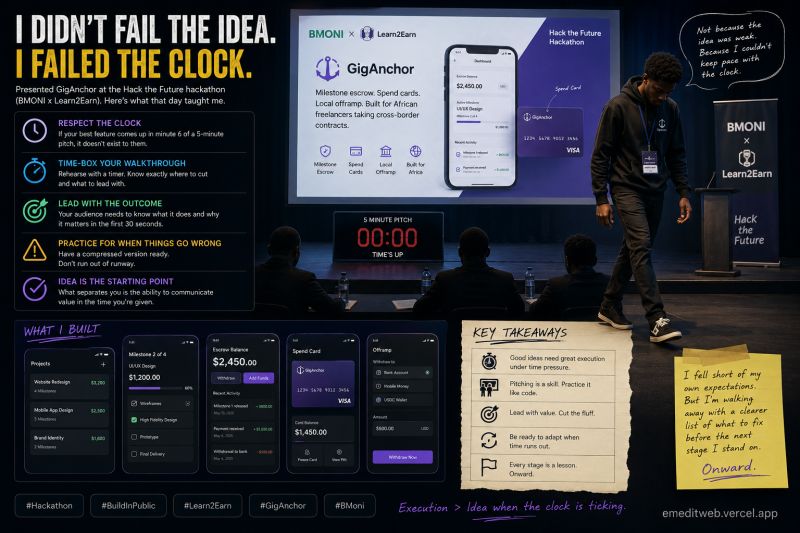
Presented GigAnchor at the Hack the Future hackathon (BMONI x Learn2Earn NG) recently, and I'm going to be honest here because pretending it went perfectly helps nobody, least of all me.
I fell short of my own expectations. Not because the idea was weak, GigAnchor was milestone escrow with spend cards and local offramp built for African freelancers taking cross-border contracts, a real problem I understood well. The gap was execution under time pressure. I couldn't keep pace with the clock, and the key functionality that actually made the project make sense never fully surfaced in the pitch. What played out in my head for days looked nothing like what played out on that stage.
I walked off feeling genuinely embarrassed. Not because someone else's idea was better, honestly I don't think it was, but because I knew the gap between what I built and what I managed to communicate was entirely on me.
Building and pitching are different skills
Having a good idea and pitching it well are two completely different skills. You can spend weeks solving a real problem, writing solid code, thinking through edge cases, and still lose the room in the first two minutes if you don't respect the clock. Nobody in that audience can see your codebase. They see what you show them in the time you're given. If your best feature comes up in minute 6 of a 5-minute pitch, it doesn't exist to them.
Rehearse with the clock running
Time-boxing your walkthrough before you ever get on stage is not optional, it's the actual work. I built the product but I didn't rehearse the presentation with a timer running. That's the mistake, not the idea itself. If I had run through my pitch three times with a stopwatch, I would have known exactly where I was overexplaining and where I needed to cut straight to the point.
Lead with the outcome
Lead with the outcome, not the build-up. When time is short, your audience needs to know what the thing does and why it matters in the first 30 seconds. The technical journey of how you built it can wait, or get cut entirely. I spent too long setting up context and not enough time landing the actual value.
Prepare for the interrupted demo
Practice the version where something goes wrong. I hadn't rehearsed what happens if I run out of time mid-demo. So when it happened, I didn't have a graceful way to compress and land the plane, I just ran out of the runway.
The idea being good isn't the finish line. It's the starting point. What separates people in that room isn't always who built the most technically impressive thing, it's who could make a stranger understand the value of their work in the time allotted. I'm not walking away from this discouraged. I'm walking away with a much clearer list of what to fix before the next stage I stand on. Time management in presentation is a skill like any other, and now I know exactly where mine broke.
Onward.
About the author

Emmanuel Itighise
Founder of Stepfi-App, @Pulsar-Stellar/sdk, and Trybe.
Emmanuel Itighise, known online as Emeditweb, is a full-stack and AI-native developer based in Lagos, Nigeria. He builds practical products and developer tools, with a focus on web applications, AI, and the Stellar ecosystem. He shares lessons from building in public, contributing to open source, and turning ideas into working software.