How $6 Billion Left Binance in Minutes: Inside the Trapdoor Attack
A compromised signing service, 50 pre-signed authorizations and a one-dollar trigger: how an on-chain trapdoor turned a Binance hot wallet into an attacker’s sweeper.
By Emmanuel Itighise
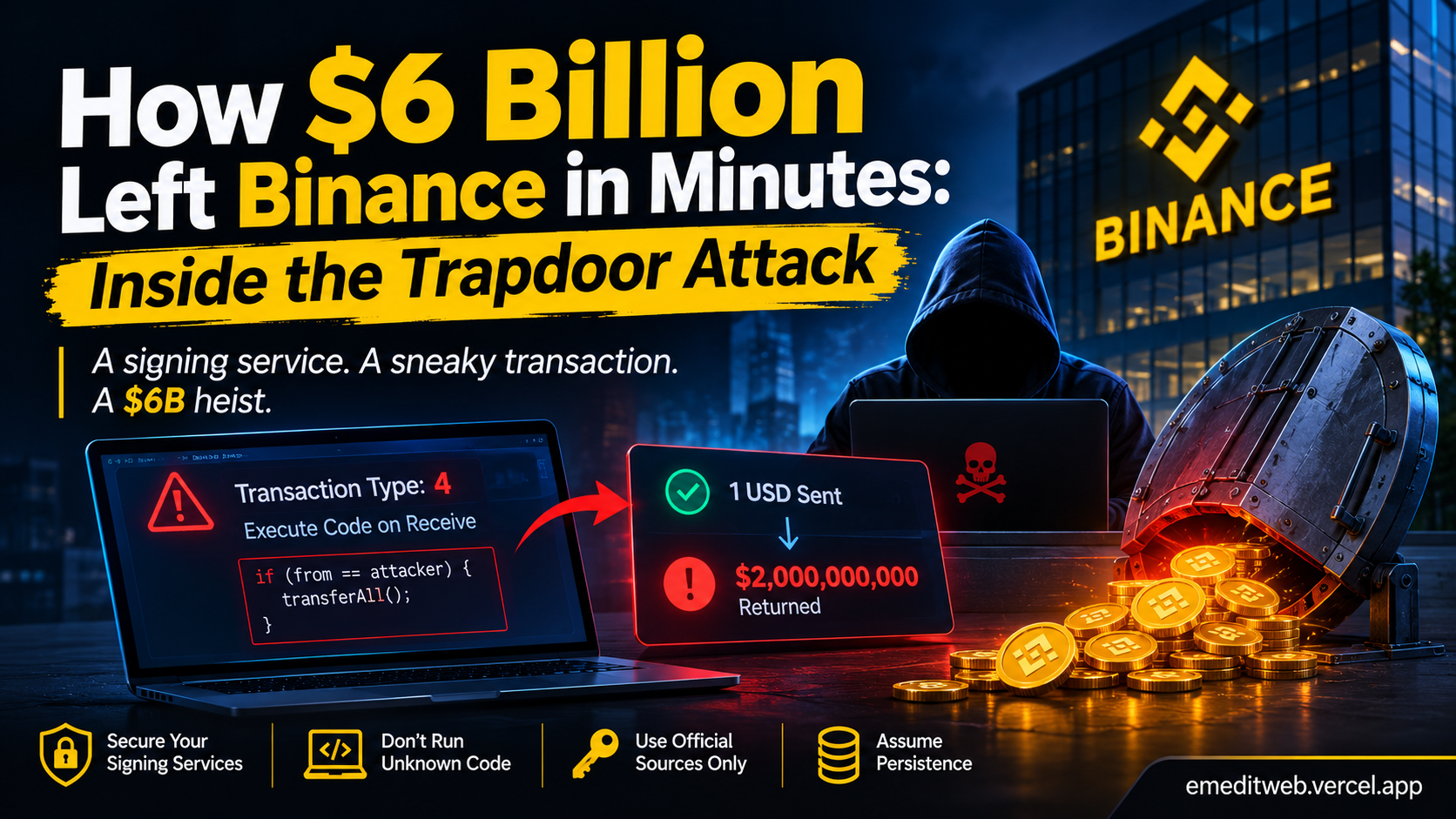
When I first heard that Binance had lost about $6 billion, I assumed someone had stolen a key and moved the money out in one big transfer. The real story is more interesting, and the detail that matters most is the first thing the attacker did.
The entry point: a signing service
Exchanges do not click “send” by hand. They run a signing service that authorizes transactions automatically with the wallet owner’s private key. Whoever controls that service can produce valid signatures. The attacker got access to it. How is covered at the end.
The trick: a transaction that plants code
An ordinary theft would be a signed transfer straight to the attacker’s wallet. That is loud and it moves one wallet at a time. The attacker used a different transaction type, known as type 4. It lets a wallet delegate execution to a piece of code that runs when the wallet receives a call. A harmless use is “when my salary arrives, pay my rent.” Here the attacker delegated a Binance hot wallet known as Binance 14 to code they had written.
The code was simple and nasty. If the attacker’s own wallet sent any amount to it, it would send everything the wallet held back to the attacker.
The catch: guessing the nonce
Every authorization must carry the wallet’s current nonce, a serial number like the one on a cheque. On a busy exchange wallet the nonce changes constantly. If you read it as 15, sign an authorization and submit it, the wallet may be on 60 by then, and your authorization is rejected.
The attacker did not try to guess the exact number. They signed 50 authorizations with 50 different nonces in a single submission, increasing the chance that one would match. TRM’s on-chain analysis describes this: a transaction with 50 pre-signed authorizations that turned an Ethereum hot wallet into a sweeper. That is a calculation, not luck.
The drain: one dollar for two billion
With the code in place, about four minutes later the attacker sent one dollar from their own wallet to Binance 14. The trapdoor fired and roughly two billion dollars came back in return. TRM reports further sweeps of the same wallet later in the evening. Each time new funds arrived, the code swept them again. An hour after the first drain, hundreds of millions more went out, and it kept happening for about four hours.
Why kicking the attacker out does not help
This is the part that stayed with me. The planted delegation lives on the public blockchain, not on Binance’s servers. Revoking the attacker’s server access does not remove it. Moving to a fresh wallet can protect future funds, but the old wallet’s delegation remains until explicitly cleared. Binance had to find it and remove it by sending its own transaction to the blockchain, about four hours in. In the meantime the attack kept working.
The money trail starts with Tornado Cash
The attacker also funded their own wallet through Tornado Cash, a mixing service designed to obscure the link between deposits and withdrawals. That makes it harder to trace where the money used to start the attack came from. TRM traced small Tornado Cash withdrawals funding an operator wallet from October 28, the day before the theft.
The bigger picture
TRM says most of the theft happened in about 20 minutes on October 29 and spread across ten blockchains. It attributes the attack with high confidence to TraderTraitor, a North Korean hacking group. Binance also attributes it to North Korea. TRM says the likely explanation is a compromise of Binance’s signing infrastructure, and Binance has said customer funds are safe.
How the attackers got in
When the first explanations appeared, nobody knew how the signing service was reached. Binance’s disclosure, as reported by Fortune, points to social engineering. An engineer was contacted by someone posing as a project director through a job platform. There was a fake HR interview, then a second interview with a supposed CEO of a company that did not exist, then an “assignment” to download. A second engineer clicked an ad for a tampered version of the Homebrew installer. Binance caught that one, but by then the attackers knew who handled the company wallets.
So the sophisticated part of the attack, the planted code and the nonce spray, started with someone downloading an attacker’s assignment.
What I’m taking from it
- Treat any assignment from a stranger as untrusted code. Open it in a throwaway VM, never on a work machine.
- Install tools from official sources. A sponsored search result is not one.
- Separate job hunting from work. Different devices and accounts.
- Protect the signing layer like the vault it is. If one machine can authorize billions, that machine and the people near it are the target.
- Assume persistence. On-chain code, malicious packages and leaked tokens all outlive a password reset. Incident response needs a way to find what the attacker left behind.
Binance has said it will publish a full incident report, and details may change as it does. I’ll update this post when it appears.
Sources
About the author

Emmanuel Itighise
Founder of Stepfi-App, @Pulsar-Stellar/sdk, and Trybe.
Emmanuel Itighise, known online as Emeditweb, is a full-stack and AI-native developer based in Lagos, Nigeria. He builds practical products and developer tools, with a focus on web applications, AI, and the Stellar ecosystem. He shares lessons from building in public, contributing to open source, and turning ideas into working software.