The skills that got me unstuck were never technical
Reading documentation, asking better questions, writing clear commits, and admitting uncertainty: the everyday habits that make a developer effective.
By Emmanuel Itighise
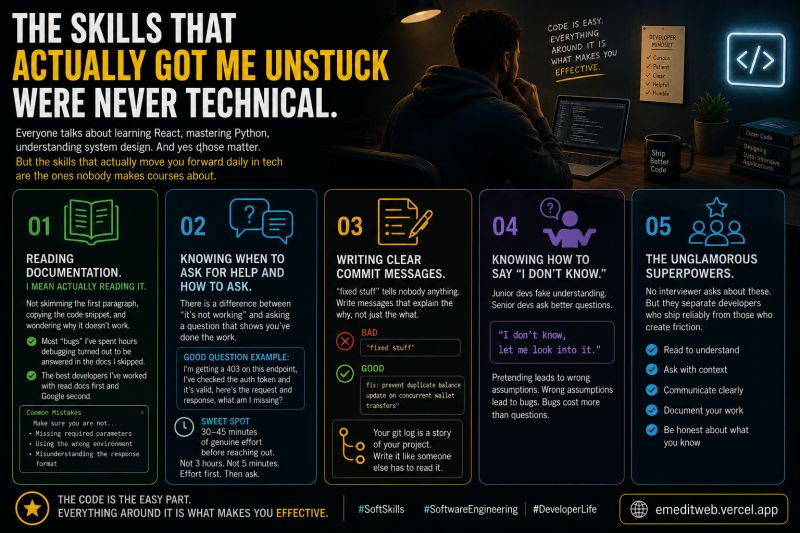
Everyone talks about learning React, mastering Python, understanding system design. And yes those matter. But the skills that actually move you forward daily in tech are the ones nobody makes courses about.
Read the documentation
Reading documentation. I mean actually reading it. Not skimming the first paragraph, copying the code snippet, and wondering why it doesn't work.
Most "bugs" I've spent hours debugging turned out to be answered in the docs I skipped. The number of times I've searched Stack Overflow for 30 minutes only to find the exact answer in the official docs under a section called "Common Mistakes" is embarrassing. Reading docs is not a sign that you don't know what you are doing. It is literally how you learn what you are doing. The best developers I've worked with read docs first and google second.
Ask better questions
Knowing when to ask for help and how to ask. There is a difference between "it's not working" and "I'm getting a 403 on this endpoint, I've checked the auth token and it's valid, here's the request and response, what am I missing." The first one wastes everyone's time. The second one shows you have done the work and just need a second pair of eyes. Knowing when to ask matters too. Spending 3 hours stuck on something without asking is not persistence, it is stubbornness. But asking after 5 minutes without trying anything yourself is not efficiency, it is laziness. The sweet spot is somewhere around 30 to 45 minutes of genuine effort before reaching out.
Write commits people can understand
Writing clear commit messages. "fixed stuff" tells nobody anything. Not your teammates, not your future self, not the person reviewing your PR three months from now trying to understand why a function was changed. A commit message like "fix: prevent duplicate balance update on concurrent wallet transfers" takes 10 extra seconds to write and saves hours of confusion later. Your git log is a story of your project. Write it like someone else has to read it because eventually someone will.
Make room for uncertainty
Knowing how to say "I don't know." Junior developers fake understanding because they think admitting confusion looks weak. Senior developers say "I don't know, let me look into it" because they have learned that pretending to understand something leads to building on wrong assumptions which leads to bugs that are ten times harder to fix than the original question was to ask.
These aren't on any job description. No interviewer asks "how well do you read documentation" or "describe your commit message style." But these are the skills that separate the developer who ships reliably from the developer who is technically skilled but constantly creating friction. The code is the easy part. Everything around it is what makes you effective.
About the author

Emmanuel Itighise
Founder of Stepfi-App, @Pulsar-Stellar/sdk, and Trybe.
Emmanuel Itighise, known online as Emeditweb, is a full-stack and AI-native developer based in Lagos, Nigeria. He builds practical products and developer tools, with a focus on web applications, AI, and the Stellar ecosystem. He shares lessons from building in public, contributing to open source, and turning ideas into working software.