Stop building what already exists. Build what's unique.
Lessons from building emedit-AI: use SDKs for shared infrastructure, focus on your product's value, and take responsibility for every external dependency.
By Emmanuel Itighise
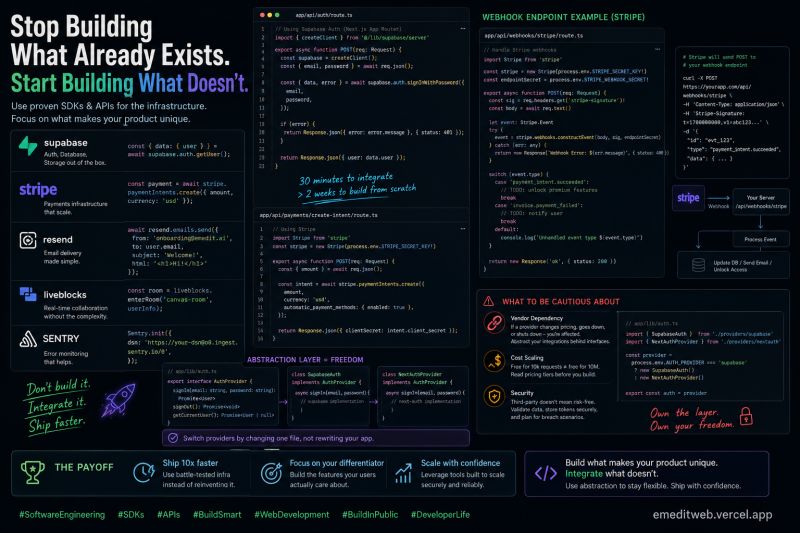
I used to want to build everything from scratch. Auth system? Let me write it myself. Payment processing? I'll handle the logic. Email notifications? I'll set up the SMTP server. It felt like real engineering. It was actually just wasted time. The reality is that most of the infrastructure your app needs already exists as an SDK, an API, or a managed service.
Supabase gives you auth, database, and storage out of the box. Stripe handles payment flows that would take months to build securely on your own. Resend or SendGrid handles email delivery. Liveblocks gives you real-time collaboration. Sentry catches your errors before users report them. These aren't shortcuts, they are tools built by teams who spend all day solving that one problem so you don't have to.
Build your differentiator
I learned this building emedit-AI. Real-time collaboration on a shared canvas sounds like something you need to engineer from the ground up. WebSocket connections, presence tracking, conflict resolution, cursor synchronisation. Liveblocks handles all of that through a clean SDK. What I actually needed to focus on was the canvas logic, the AI architecture generation, and the user experience. The real-time layer is critical infrastructure but it is not my differentiator. Knowing the difference between the two saved me months.
Own your dependencies
Vendor dependency is real. If your entire auth system runs on one provider and they change pricing, go down, or shut down their free tier, your app is affected and you have no fallback. I saw this play out last week when OpenAI cut off Cursor after SpaceX acquired them. One corporate decision and developers lost access to models they built their workflow around. The fix is abstraction. Don't hardcode a vendor's SDK into every corner of your codebase. Wrap it behind an interface so that swapping providers means changing one file, not rewriting your entire app.
Read the pricing before you scale
Cost scaling catches people off guard. A service that is free for 10,000 requests per month becomes expensive at 10 million. Always read the pricing tiers before you build on something, not after you have 50,000 users and a bill you didn't plan for.
Keep responsibility for security
Security is not automatic just because you are using a third-party service. You still need to validate what data you are sending to external APIs, how tokens are stored, and what happens if that service gets breached. Their security incident becomes your security incident if your users' data was in the pipeline.
Build what makes your product unique. Integrate what doesn't. But own the abstraction layer between your code and every external dependency so you are never locked in.
About the author

Emmanuel Itighise
Founder of Stepfi-App, @Pulsar-Stellar/sdk, and Trybe.
Emmanuel Itighise, known online as Emeditweb, is a full-stack and AI-native developer based in Lagos, Nigeria. He builds practical products and developer tools, with a focus on web applications, AI, and the Stellar ecosystem. He shares lessons from building in public, contributing to open source, and turning ideas into working software.